Showing posts with label David Lloyd. Show all posts

Monday, 5 November 2007

“Bang!” Goes Another Fifth of November

As the whizzes, pops and bangs scare the seagulls on another Bonfire night, either celebrating or lamenting Guy Fawkes’ failure to blow up the King and Parliament*, here are some panels that have probably popped up on more than one blog today. I’m sorry to break up the layout, but they are, at least, in gloriously stark black and white, as artist David Lloyd intended.


That the clock tower apparently blows up in silence, and that the fireworks are accompanied by no whizzes, pops or bangs, is a reminder of another of Lloyd’s intentions. As he put it when interviewed for the Comics Britannia TV series:

”The idea of getting rid of thought balloons and sound effects was motivated by me wanting to get people to read comics who didn’t normally read comics, because one of the things that often puts people off is the “Bam! Pow! Zap!’ stuff. Everybody knows that when a gun goes off it goes ‘Bang!’, so you don’t actually need to tell them, not if they’re intelligent adults. And thought balloons were a kind of artificiality that you don’t get in any other kind of entertainment.”

We’ll leave aside for the moment the question of whether people who don’t normally read comics were ever likely to pick up Warrior issue 1, with its gaudy cartoon cover. In the longer run, many such people probably have read the collected paperback V for Vendetta.


We’ll also leave aside the dismissal of thought balloons, save to note that novels also frequently recount their characters’ thoughts, and that many a dramatist or screenwriter who has had to resort to soliloquy or voiceover must have envied comics having so neat a device to let readers into their protagonists’ heads.

For the moment. let’s stick with sound effects. Lloyd’s collaborator on V for Vendetta, Alan Moore, carried the aesthetic of omitting thought balloons and sound effects forward into Watchmen, one of the two comics most influential on subsequent anglophone adventure stories. The abolition of thought balloons proved to be a very successful meme, partly because Moore, and Frank Miller in The Dark Knight Returns, simultaneously provided an alternative: the first-person narrative caption box. But sound effects have proved harder to eradicate, even though, as Lloyd notes, they are at the heart of the easy mockery sub-editors pour into every mainstream headline about comics. Why?

In part, it is because Lloyd is surely wrong about sound effects being unnecessary. What if that gun went off in the next room or was hidden inside a bag? What if the point the cartoonist wanted to convey was how loud (or how soft) it sounded to the characters? What if what is being shown in the pictures is not a familiar action? Nothing is as simple and effective as writing down the sound, and it is, on the face of it, no more artificial than writing down in a word balloon the sounds the humans are making.

And yet, sound effects often do seem silly. We tend to blame memories of the 1960s Batman TV series for the derision heaped on “the ‘Bam! Pow! Zap!’ stuff”. Yet there was a reason why the TV producers singled out sound effects for the on-screen treatment. After all, they didn’t put up intertitles to display Adam West’s dialogue in word balloons. The reason, I think, is that onomatopoeia is naturally funny. Consider how much less amusing it would be if Thurber’s references to Walter Mitty’s “ta-poketta-poketta” were all replacing by descriptions of a jerky, rhythmic sound instead.

So we seem to be at an impasse. Sound effects are often needed, but may be inherently risible. I wonder, though, if some clues to a way out could be presented by manga?

Manga, as presented in the USA, are often published in a half-translated form. The aspect of this most remarked upon is that they generally retain an orientation that requires reading the page from right to left. But it is also common practice to leave sound effects in situ but untranslated.


The effect, at least to a non-reader of Japanese, is that the panel alerts the reader to the fact that a sound is being made, but leaves us to decide for ourselves what that sound is. This can be remarkably effective (your idea of how the sound of a zipper or an approaching train should best be rendered probably differs from mine – here we can each interpolate our ideal), and though it lacks specificity, it avoids the onomatopoeia trap. I’m not suggesting that anglophone cartoonists should letter their sound effects in Japanese, but perhaps some literally non-literal approaches might be suggested by the manga effect.

Anyway, the whizzes, pops and bangs have now died down outside my window, so I’ll take advantage of lack of sound effects to get some sleep.

* For a reminder of what Robert Catesby and his stooge, the real Guy Fawkes, were trying to do to the Palace of Westminster, click here.


Panels
V for Vendetta Chapter 1 “The Villain” by Alan Moore and David Lloyd, Warrior Issue 1, Quality Communications, March 1982 (Cover: Laser Eraser and Pressbutton drawn by Steve Dillon)

The Kurosagi Corpse Delivery Service Volume 3 by Eiji Otsuka (story) and Housui Yamazaki (art), English-language edition published by Dark Horse Comics, 2007

Monday, 1 October 2007

Burning Down the Houses

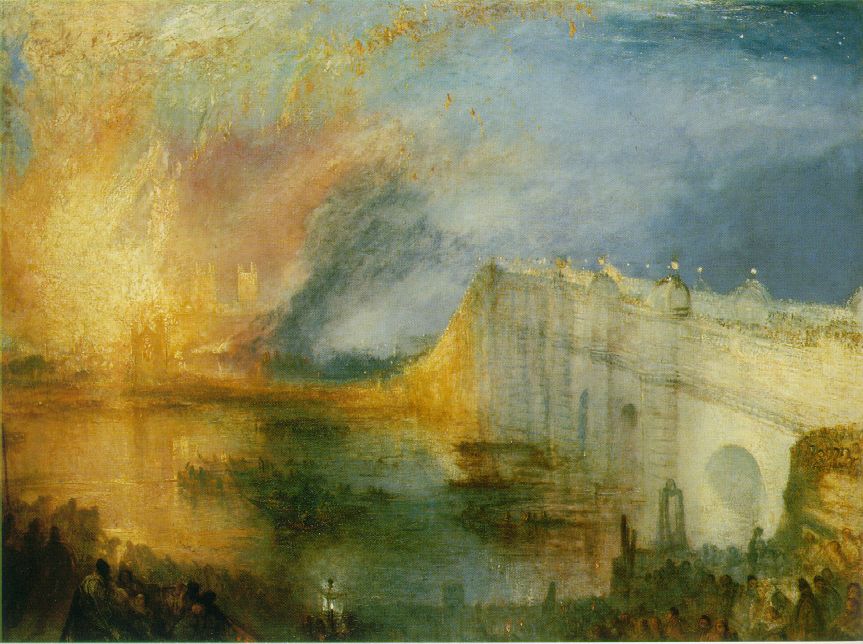
It isn’t comics, but I couldn’t let mention of the burning of the Houses of Parliament in 1834 go by without bringing in JMW Turner. Probably the greatest of all English artists (admittedly not a crowded field, unless you adopt Wildstorm’s definition of “fine art”), Turner watched the fire from a boat in the Thames, and made four paintings of it.


Pictures
JMW Turner The Burning of the Houses of Lords and Commons, 16th October 1834, oils, 1835, now in the Philadelphia Museum of Art. Scan from Webmuseum Paris

JMW Turner Burning of the Houses of Parliament, oils, 1835, now in the Cleveland Museum of Art. Scan from Magellan’s Log

JMW Turner Burning of the Houses of Parliament, watercolour, 1834 or 1835, scan taken from In Defence of Marxism

JMW Turner The Burning of the Houses of Parliament, watercolour, 1834 or 1835, now in the Tate Museum, whence this scan

V for Vendetta Chapter 1, “The Villain" by Alan Moore (script) and David Lloyd (art), Warrior issue 1, Quality Communications, March 1982

Friday, 8 June 2007

Doctorless Who

When the BBC decided to order a special Christmas episode of Doctor Who every year, it created a problem for the production team, as there was no extra time in their schedule. Their answer was to film two episodes back-to-back, but since David Tennant can’t be in two places at once, that effectively means that one episode a year has to get by without the Doctor for most of its running time. This year’s almost-Doctorless Doctor Who episode, Blink, airs on BBC1 on Saturday.

Completely Doctorless stories set in the worlds of Doctor Who have been around in comic strips for a while. Mostly, they have been about the Daleks, as you might expect. The first appeared in The Dalek Book of 1964, which told of the Daleks’ assault on our solar system in preparation for their invasion of Earth. The Dalek Book was in the hard-backed Annual format, and credited as written by David Whitaker and Terry Nation, though it is likely that Whitaker, Doctor Who’s first script editor and author of much of its early ancillary fiction, did most of the work.


Together with one of the artists on The Dalek Book, Richard Jennings, Whitaker went on to produce The Daleks comic strip in TV Century 21, the only feature in that comic not based on a Gerry Anderson TV series. The TV21 strip, later drawn by Eric Eden and most memorably by Ron Turner, took the Daleks from their creation to their discovery of the Earth. You can see a sample here.

The success of The Dalek Book led to two sequels over the next two years. During that time, Terry Nation tried to pitch a Dalek TV series, without the Doctor, to US networks. Among the human heroes he intended to feature was a character from the Doctor Who story now commonly known as “The Daleks’ Master Plan”, Special Space Security (or Space Security Service – it varied) Agent Sara Kingdom, even though she had actually been killed at the end of that story. The TV series pitch came to nothing, but it was used as the background for The Dalek Outer Space Book of 1966. As a result, Sara Kingdom became the first Doctor Who supporting character to feature in her own solo comic strip, in which even the Daleks did not appear.


After a long lull, four more Dalek annuals appeared in the 1970s, though only two of them featured new comic strips, none very notable. But at the end of that decade, Marvel UK launched Doctor Who Weekly. At first, the new comic magazine was strip-heavy, featuring a new Doctor Who strip, a reprint of old Marvel Comics stories that the editors felt were a reasonable fit (starting with an adaptation of The War of the Worlds), and a second new strip at the back, which featured elements of Doctor Who other than the Doctor himself.

Naturally, the Daleks kicked this series off. But they were soon followed by Cybermen, Sontarans, Ice Warriors, K9, UNIT and many others. The stories drew on a range of British talents yet to be poached by US comics, including Steve Dillon, David Lloyd and Paul Neary. At first, the stories were all written by Steve Moore, but later others took a hand. Alan Moore wrote a sequence of stories about the Time Lords, fighting a war that had yet to break out, in which he introduced his super-team, the Special Executive. Since they later turned up in Captain Britain, that may mean that there’s a Gallifrey in the Marvel Universe.


One story written by John Peel (not the famous DJ), about the Celestial Toymaker, featured some particularly memorable art by Mick McMahon.


These back-up strips continued after the Weekly went monthly, but became less frequent, and in 1982 they stopped altogether: the magazine’s budget was under pressure, comics pages were more expensive than prose, and the lead Doctor Who strip was the priority.

In the 1990s, there were a couple of notable Doctorless strips in Doctor Who Magazine. In 1995, they ran a continuation of the Daleks strip from TV21, written by John Lawrence with art once again by Ron Turner. Sadly, Turner’s death brought that to an end. A Cybermen strip written by Alan Barnes and drawn by Adrian Salmon also ran for a short while, and then the magazine reverted once again to the single lead strip.

As I type this, there is more Doctorless Doctor Who spin-off fiction around than ever before. There are two TV series, Torchwood and The Sarah Jane Adventures. There are Torchwood novels. BBC Children’s Books has put out a series of slim hardbacks about various elements of Doctor Who - one on Rose, one on Cybermen, one on the Sycorax and so on – and each features an appropriate short story. Big Finish produces authorised audio plays about the Daleks, and Sarah Jane, and Romana and Leela’s political adventures on Gallifrey, among others.

There are also more authorised Doctor Who comic strips than ever, in Doctor Who Magazine and Doctor Who Adventures and Doctor Who: Battles in Time. But there are no Doctorless Doctor Who spin-off strips. Which is as much a pity as it is a paradox.


Panels
The Daleks “Invasion of the Daleks”, written by David Whitaker, art by Richard Jennings, The Dalek Book, Panther Books/Souvenir Press, 1964

Sara Kingdom, Space Security Agent, written by Brad Ashton ,art by one of John Woods, Leslie Waller or Art Sansom, from The Dalek Outer Space Book, Souvenir Press/Panther Books, 1966

“4-D War”, written by Alan Moore, art by David Lloyd, Doctor Who: A Marvel Monthly issue 51, April 1981

“The Greatest Gamble”, written by John Peel, art by Mike McMahon, Doctor Who: A Marvel Monthly issue 56, September 1981